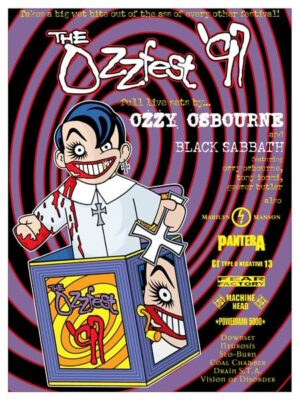
Main Stage
- Black Sabbath
- Ozzy Osbourne
- Marilyn Manson
- Pantera
- Type O Negative
- Fear Factory
- Machine Head
Second Stage
- Powerman 5000
- Slo Burn
- Drain STH
- Downset
- Neurosis
- Vision of Disorder
- Coal Chamber
This was it — my very first concert.
I was spending the summer in Columbus with my aunt, and there was no way I was missing the chance to see Marilyn Manson, Pantera, and the Prince of Darkness himself. For a 17-year-old metalhead from Flatwoods, Kentucky, this wasn’t just a show — it was mythology made tangible. I was working as a dishwasher for minimum wage — $4.25 an hour — and a $25 lawn ticket, plus parking, food, and water, represented roughly half of a two-week paycheck.
It was irrational. It was irresponsible. It was absolutely non-negotiable.
I wasn’t missing that show for anything.
It turned out to be one of the most important $25 decisions of my young life, sparking what became a lifelong, mildly addictive love affair with live music.
Being young and attending my first festival meant arriving when the gates opened. I wasn’t going to miss a second. My aunt slipped me a few dollars for breakfast. Ten bucks at Bob Evans beat twenty dollars for soggy nachos inside the venue. That morning quietly began a ritual I still keep: the pre-show fill-up meal. For me, breakfast food remains the sacred ritual before the sacrament of social distortion.
Walking into Polaris Amphitheater felt like stepping into scale I had never experienced. The lawn alone seemed endless. The crowd — more than 18,000 people — was roughly twice the population of my hometown. Black shirts stretched in every direction. Chains glinted in the muted light. Cigarette smoke drifted through thick Ohio humidity. The low hum of anticipation vibrated like a generator beneath everything.
In retrospect, the day began innocently enough. But to a kid from Flatwoods, it was sensory overload.
As the afternoon unfolded, I noticed a cultural split forming in the crowd.
On one side were the young Manson devotees — fishnets, leather, smeared eyeliner, and theatrical defiance painted across pale faces. On the other were the traditional metal faithful: leather vests, graying ponytails, and denim stitched with decades of patches. They were there for Black Sabbath, Ozzy, Pantera, Type O Negative — lineage metal.
The old heads hated Manson.
They jeered. They threw cups. They folded their arms in visible contempt. It led to tense exchanges, but mostly it was mutual glares and generational judgment. To me, it was baffling. It felt like the older generation had forgotten what it meant to love art that offended polite society.
Looking back, it wasn’t really about Manson. It was about ownership. Every generation of fans thinks they discovered rebellion, and when the next version arrives — louder, stranger, more theatrical — it feels like dilution instead of evolution. The same instinct that made Sabbath scandalous twenty years earlier was now being weaponized against Manson. Counterculture ages. And when it does, it forgets it was once counter.
Still, at 17, I wasn’t thinking about all that.
I was thinking about the music — and the young women.
The sky stayed low and gray all day, misting just enough to soften the lawn. The weather added texture to everything. It wasn’t raining exactly, but it certainly wasn’t a bright shining day. If anything, the overcast drizzle added to the rich tapestry I was experiencing for the first time. The weather fit the music! The lawn slowly transformed from grass to sponge. By the time Type O Negative took the stage, someone had the obvious idea.
Mud.
At first it was slipping and laughing. Then full-on wrestling. Shoes abandoned. Shirts discarded. The lawn churned into something between earth and clay.
I’d estimate the mud wrestling pit was about 75% young women, with most of the guys having migrated toward the more traditional mosh pits. Chest-bumping, elbow-throwing, sweat-soaked aggression has its place. I’ve moshed plenty in my life.
But that afternoon?
Given the option between colliding with drunk, shirtless dudes or wrestling with a bunch of laughing young women in their underwear, the choice was pretty fucking easy.
I’ve always leaned more lover than fighter when given the opportunity.
So while there were pits that thundered with boots and shoulders, our corner of the lawn felt playful, conspiratorial, almost cinematic. We slipped. We fell. We pulled each other back up, mud streaking down our faces and clinging to our hair. It coated everything in a thin layer of earth and mischief. I think for all of us, it was a feeling of freedom that cannot be replicated in the modern, digital world. It is sadly a feeling I’m not sure my children have ever been able to truly enjoy.
Anyways, it was far different from moshing. Less about impact, more about immersion. It was the most fun most of us had ever had in our lives.
Then Pantera came out.
When they tore into “Walk,” the ground seemed to respond. Dimebag’s riffs didn’t just sound loud — they felt tectonic. We were down to our skivvies, caked in mud like some Appalachian audition for Woodstock, when something shifted again.
Someone ripped up a chunk of sod.
It came free as a thick square of earth with roots exposed like veins. They launched it skyward. It arced against the gray sky and vanished into the mass of bodies.
Then another.
Then ten.
Then hundreds.
Within minutes, the lawn became ammunition. People twisted their hands under the turf, freeing fist-sized clumps of earth and grass and hurling them overhead. You’d look up and see thousands of dark shapes suspended against the clouds before raining down into the crowd.
It was primal. It was absurd. It was communal.
Strangers would lock eyes, grin like lunatics, and launch another one together. You couldn’t stand still without risking impact. Dirt smacked shoulders. Grass slapped faces. The very ground beneath us was disassembling under Pantera’s soundtrack.
In hindsight, it wasn’t random. It was physics — social and emotional. Hours of anticipation. Alcohol and other substances. Youth. Noise. A crowd that large doesn’t just consume energy; it amplifies it. Once one person tears up the ground, participation spreads because action feels safer inside madness. The same instinct that builds stadium chants can just as easily build chaos.
That afternoon, it was all just joy.
But the mechanism was already there.
And it didn’t stop that year.
This madness became a tradition, and every year the Polaris lawn bore the scars. What started as spontaneous chaos hardened into ritual. Major acts like Rob Zombie and Tool would even reference the infamous sod-throwing from the stage, daring and encouraging the crowd to let it fly again. And we did!
But that first time, in 1997, it wasn’t tradition.
It was invention.
Then Manson came on.
The mood darkened.
Hostility grew louder. And layered on top of that tension were the protesters.
That was another first for me.
Growing up in Flatwoods, protesters were presented as something historical, not really a part of contemporary society. Yet here they were — lining the Polaris exit with signs warning us of eternal damnation. Some stood at the entrance. Others flew banners over the venue. It felt less like outreach and more like condemnation, which seemed pretty on-brand compared to my experience with the religious folks I grew up with in Kentucky.
Rumors later spread that some zealots had taken jobs at Polaris to sabotage equipment. During Manson’s set, technical issues mounted. Songs cut out. Equipment failed. They completed only a handful of songs cleanly before frustration boiled over. Whether sabotage or coincidence, it felt targeted in the moment. They had gotten to the Antichrist Superstar.
They trashed what they could and walked off.
Then we waited.
Ozzy’s band eventually walked out — without Ozzy.
Instead, we got a surreal summit: Phil Anselmo, Dimebag Darrell, Peter Steele, Marilyn Manson — all jamming with Ozzy’s band. They launched into five songs. I vividly remember “Mr. Crowley,” “Crazy Train,” and “Bark at the Moon.”
For thirty minutes, it felt like Christmas morning for metal fans. Dimebag’s solo on “Crazy Train” felt apocalyptic, like he was ripping open the sky with distortion.
We assumed Ozzy would appear at any moment.
He never did.
A staff member walked out and casually announced, “Sorry guys, Ozzy can’t make it. Drive safe.”
In retrospect, that’s where the real mistake happened.
Crowds are elastic. They can absorb disappointment if you manage the tension. But you don’t stretch them to the breaking point and then snap the cord. They let us believe Ozzy was coming. They let anticipation swell. Then they cut it off in two sentences.
The riot wasn’t just about absence.
It was about expectations being mismanaged in front of 18,000 emotionally primed people.
Confusion turned to fury.
Fencing buckled. Kiosks were overturned and set ablaze. Seats were ripped from anchors. Smoke rose in thick columns against the night sky. Riot police arrived in formation. A dealership’s show car lay flipped on its side.
While I had no interest in causing widespread property damage, I certainly wasn’t leaving without a souvenir piece of the fence, so I circled around and snapped off a piece before heading toward the parking lot — a piece I still have to this day.
It was chaos — raw and combustible.
Since then, many competing stories have emerged as to why Ozzy was unable to perform that day. Ozzy himself has said he was sick and his throat couldn’t handle it. Others have said it was drugs — that his wife Sharon had found his stash and hid it, and he refused to get off the plane without them. Others have said he got so trashed on the flight that he simply couldn’t stand and sing.
Frankly, I don’t think it really matters.
Those of us who were there wouldn’t trade the experience.
In the years since, many have lamented that there’s little footage of that night. No smartphones. No viral clips. No endless replays.
And honestly?
I kind of like that.
It lives only in the memory of those who were there — flawed, exaggerated, personal. Memory becomes collaborative mythology. No one can fact-check how high the sod flew or how bright the fires burned.
Documentation changes participation. Today, half the crowd would have been filming the first fence panel coming down instead of feeling the shift in the air. I don’t fear technology. I don’t resist the future. But sometimes I think we’d be better off putting the phone down and simply being human in real time.
That night was human.
Two weeks later, Ozzy and Black Sabbath returned to Polaris. It was one of the best concerts I’ve ever seen — and I’ve seen Ozzy five times. He seemed grateful. Looser. At one point he joked, “Hey, try not to tear the fuckin’ place down again, you animals.”
When he tore into “Mr. Crowley” that night, it sealed itself as a top-five concert moment of my life.
My first concert ended in a riot.
And I was hooked forever.